
METCON TMT: Kerala’s First 5-Star Green-Rated Steel
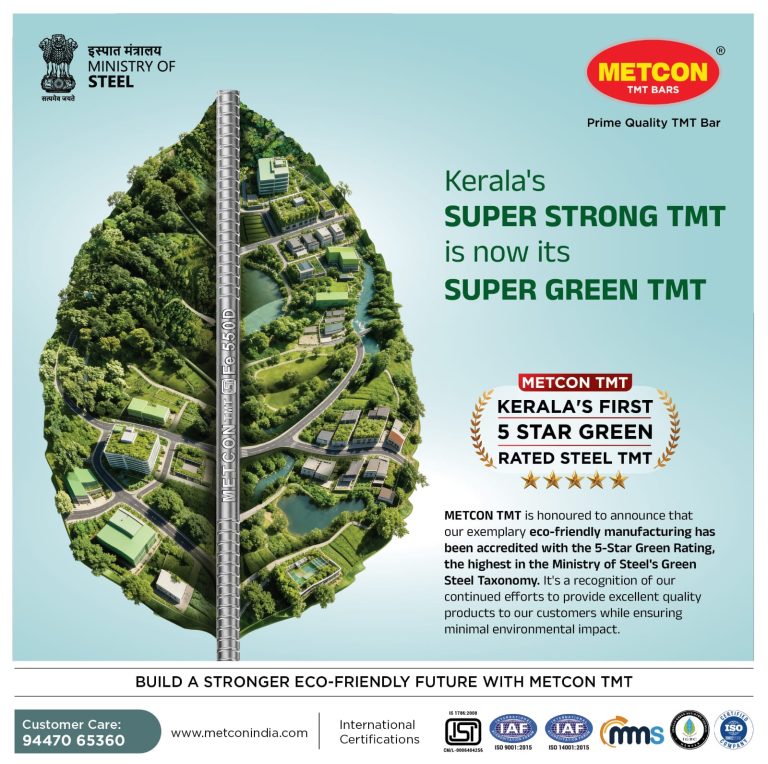
METCON TMT has officially set a new benchmark for industrial sustainability by becoming the first steel brand in Kerala to achieve the prestigious 5-Star Green-Rated Steel Certification. This accreditation, awarded under the Central Ministry of Steel’s Green Steel Taxonomy, recognises METCON’s commitment to producing steel with the lowest possible carbon footprint—specifically maintaining an emission intensity below 1.6 tonnes of CO2 per tonne of finished steel.
State-of-the-Art Eco-Friendly Production
Our leadership in green steel is driven by a relentless investment in a state-of-the-art manufacturing plant equipped with the latest global machinery. Unlike traditional smelting processes, METCON utilises innovative air-filtration technology that captures and treats harmful gases emitted during production. This ensures that only clean, filtered air is released into the atmosphere, significantly reducing local pollution.
Furthermore, we are dedicated to resource conservation. Our facility employs an advanced water recycling system that treats and reuses industrial water, drastically reducing our reliance on local aquifers and preventing groundwater depletion. By combining these processes with high-quality international raw materials, we produce TMT bars that are as kind to the planet as they are resilient in structures..
Empowering Corporate Green Commitments
LEED & WGBC: Our verified low-carbon profile contributes directly to "Materials and Resources" credits, helping projects meet World Green Building Council (WGBC) standards for net-zero embodied carbon.
GRIHA: As a government-accredited green product, METCON simplifies the documentation process for GRIHA’s "Low-Embodied Energy Materials" criteria.
EDGE: Developers can achieve EDGE certification faster by using our steel to meet the 20% reduction target in embodied energy.
By partnering with METCON, you aren’t just building structures; you are building a greener legacy for Kerala and the world.
For more details, visit:
Leading the Global Shift: India’s Green Steel Taxonomy
As the world’s second-largest steel producer, India has taken a historic leap toward industrial decarbonisation. With the launch of the Green Steel Taxonomy in December 2024, the Ministry of Steel has established a pioneering framework to define, measure, and certify low-carbon steel. This initiative is a cornerstone of India’s National Mission on Green Steel, directly supporting the nation’s 2070 net-zero goals while ensuring our industry remains globally competitive in an increasingly climate-conscious market.
Defining “Green Steel” in the Indian Context
For the first time, “Green Steel” is not just a buzzword but a regulated standard. The taxonomy defines Green Steel based on its carbon emission intensity. To qualify, a plant must produce finished steel with an emission intensity of less than 2.2 tonnes of CO₂ equivalent per tonne of finished steel (tfs).
The “greenness” of the product is calculated as a percentage, representing how much lower a plant’s emissions are compared to this 2.2 threshold. This ensures a transparent, data-driven approach to sustainability that rewards efficiency and innovation.
The Star Rating System: Benchmarking Excellence
| Rating |
Emission Intensity (t-CO₂e/tfs) |
Classification |
|---|---|---|
|
5-Star |
Below 1.6 |
Highest Green Standards |
|
4-Star |
1.6 – 2.0 |
Advanced Low-Carbon |
|
3-Star |
2.0 – 2.2 |
Early-Transition Green |
|
No Rating |
Above 2.2 |
Conventional Steel |
Comprehensive Emission Tracking (Scope 1, 2, and 3)
India’s taxonomy is rigorous. It covers Scope 1 (direct plant emissions) and Scope 2 (purchased electricity). Crucially, it includes Limited Scope 3 emissions, accounting for carbon-intensive upstream processes like:
- Agglomeration (Sintering and Pellet making)
- Coke making
- Beneficiation and embodied emissions in raw material
Certification and Verification: The Role of NISST
- Measurement & Reporting: Verifying plant-level data.
- Certification: Issuing annual Greenness Certificates.
- Market Trust: Providing the foundational data needed for green public procurement and preferential financing.
