


Steel is usually discussed in Kerala only after the rate changes. That is the mistake.
By the time a house owner, contractor, or project engineer starts arguing over the price of steel, the real decision has already been weakened. The foundation drawing is ready. The soil work has started. The contractor is under pressure. The lorry is waiting. Someone says, “Use any good brand, all are same.” They are not.
Green Rated TMT Bars are not simply ordinary bars with a cleaner label. A 5-star green rating, under India’s green steel framework, points to verified lower emission intensity during steel production. That matters because steel is not a small item in construction. It is inside every beam, column, footing, slab, lintel, staircase, retaining wall, and compound wall that people stop noticing once the plaster is done.
In Kerala, people talk about vastu, elevation, tiles, kitchen finish, imported sanitary fittings, ceiling lights, and gate design. Steel gets less emotional attention because it disappears early. Yet that hidden material decides how calmly a building carries load, movement, moisture stress, and time.
A green rating does not mean the bar can be used carelessly. It does not rescue poor structural design. It will not compensate for wrong spacing, honeycombing, low cover, weak concrete, poor curing, sea-sand contamination, or a mason bending bars until the ribs are damaged. No honest professional should say otherwise.
What it does bring is a better purchasing discipline. The buyer is no longer selecting only by name, price, or dealer confidence. There is a measurable environmental standard behind the product. For Kerala, where construction is heavy, land is tight, rain exposure is aggressive, and sustainability is no longer just a seminar word, that is not a small shift.
Kerala Buildings Need Steel That Understands Moisture, Not Just Load
Kerala is not an easy place for reinforced concrete. The air is wet for much of the year. Monsoon water finds weak points. Laterite soil behaves differently from site to site. Coastal belts carry chloride exposure. Hill areas bring slope pressure and retaining-wall stress. Town plots are narrow, so buildings go vertical even when the soil investigation is treated like an optional expense. Renovations happen without understanding old reinforcement. Plumbing leaks sit inside slabs for months before anyone opens the ceiling.
Steel inside concrete is protected only when the whole system behaves properly. That is why I disagree with the common advice that “higher strength bar is always better”. Not always. A bar must match the design, bend properly at site, bond well with concrete, and come from a controlled manufacturing route. Strength without ductility is not comfort. Strength without traceability is a gamble. Strength without site discipline is theatre.
Good TMT Steel Bars should give the engineer confidence not only on paper but during bending, tying, placement, concreting, and long-term service. In Kerala, corrosion risk often begins with small mistakes. A stirrup placed too close to the shuttering. A column cover block replaced with a broken tile piece. A slab left without proper curing. Rainwater pooling during construction. Salt-laden storage near coastal sites. Bars lying directly on wet ground for days.
These details rarely appear in online articles. They decide the life of buildings. Green Rated TMT Bars bring an environmental advantage, yes, but they should still be judged through the old professional lens: consistency, bendability, rib pattern, test certificate, batch traceability, dealer reliability, and suitability for the structural design. A green rating is valuable because it adds one more layer of seriousness to procurement. It should never become an excuse to stop checking the basics.
The Environmental Benefit Is Real, But It Must Be Properly Understood
The word “green” has been overused. Paint a logo green, plant two saplings, mention carbon footprint, and suddenly every product starts sounding responsible. Construction buyers have become suspicious, and rightly so. They have heard too many promises.
A 5-star green steel rating is different when it is linked to a defined emission threshold and verification process. The point is not vague eco-friendliness. The point is lower carbon intensity in production. That matters because steel manufacturing is energy-heavy, and every tonne of steel carries an environmental cost before it reaches a site in Alappuzha, Kochi, Kozhikode, Kottayam, Thrissur, Palakkad, Kannur, or Thiruvananthapuram.
For a house owner, the benefit may not look dramatic at first. The beam will not look greener. The slab will not cure faster. The mason will not tie it differently. The invoice may look similar to any other steel purchase.
The difference sits upstream. When a project chooses Green Rated TMT Bars, the embodied carbon of the structure can be reduced compared with higher-emission alternatives. For larger residential apartments, hospitals, schools, commercial buildings, warehouses, hospitality projects, and institutional buildings, that choice becomes part of the project’s sustainability record. Architects and developers who are moving towards green building documentation cannot ignore this. Material selection is becoming evidence-based.
Kerala has reached a stage where premium construction cannot be judged only by marble, façade lighting, and imported bathroom fittings. A responsible building now has to answer harder questions. Where did the material come from? Was it produced efficiently? Can the manufacturer show proof? Will the building owner have documentation if the project later seeks green certification, ESG reporting value, or institutional credibility?
A 5-star rating helps there.
Still, it is worth saying plainly: green steel is not automatically a green building. A wasteful design using better steel is still wasteful. A poorly ventilated glass-fronted building in Kerala’s climate is not sustainable just because its reinforcement has a green rating. Material choice helps. Design discipline helps more. Both together begin to make sense.
Better Procurement Reduces the Usual Site-Level Confusion
A reliable TMT Bar Manufacturer does more than produce bars. It reduces uncertainty.
That uncertainty is common in Kerala construction. A contractor asks for one brand, the engineer recommends another, the owner checks the day’s rate, the dealer suggests available stock, and the final decision is made over the phone. Sometimes bars arrive without proper checking. Sometimes different batches are mixed casually. Sometimes the diameter is assumed by sight. Sometimes 8 mm stirrups, 10 mm distribution bars, and 12 mm main bars are treated like interchangeable items by people who should know better.
They are not interchangeable. A serious TMT Bar Company in Kerala should make it easier for buyers to verify what they are purchasing. Brand marking on the bar, invoice clarity, test certificates, batch details, correct diameter, correct grade, and dealer accountability all matter. The green rating is useful because it raises the level of documentation expected from the supply chain.
This is where the local dealer network becomes important. Good TMT bar dealers in Kerala are not just traders moving stock. The better ones understand site urgency, cutting schedules, bar bending needs, delivery access, storage issues, and the difference between a small house site and a commercial project where delays cost heavily. A strong dealer cannot replace an engineer, but a careless dealer can create expensive confusion.
There is also the stirrup question.
Stirrups are treated casually on too many sites. They should not be. The Best Stirrup in Construction in Kerala is not the one that simply looks neat in a bundle. It is the one made to correct dimensions, with proper bends, hooks, spacing discipline, and steel quality that does not crack or lose shape during handling. In columns and beams, stirrups control confinement, shear resistance, and the behaviour of reinforcement under stress. When stirrups are wrong, the structure may still stand, but it has already lost part of its intended performance.
Green certification does not correct a badly made stirrup. Proper manufacturing and proper fabrication must go together.
Durability Is Built Before the Concrete Is Poured
People notice durability only when failure begins.
A crack near a balcony edge. Rust stains coming through plaster. A column corner breaking near the car porch. A sunshade sagging. Dampness around a bathroom wall. A slab repair after ten years that should not have been needed for thirty.
By then, the conversation becomes expensive. Steel durability depends on the quality of the bar, concrete cover, concrete quality, workmanship, exposure conditions, drainage, waterproofing, and maintenance. It is never one factor. That is why exaggerated steel claims should be treated carefully. No TMT Steel Company can honestly promise that its bar alone will make a building durable if the concrete is poorly mixed and cured.
Yet steel quality still matters. Consistency matters. A bar that bonds well with concrete matters. A bar that bends properly without surface damage matters. A manufacturer that follows controlled processes matters. Documentation matters when disputes arise.
Green Rated TMT Bars can support durability indirectly by coming from a manufacturing culture where measurement and process control are taken seriously. The environmental rating is about emissions, not a direct durability certificate. That distinction is important. Still, companies that invest in verified green production often tend to treat process accountability as part of their market position. For project owners, that is useful.
In residential buildings, this matters because most families in Kerala build once. They stretch budgets. They sell land. They take loans. They spend years planning. Then, during construction, some of the most permanent decisions are made in a hurry. Saving a small amount on reinforcement may feel clever during purchase. It rarely feels clever when corrosion repairs begin before the building has aged properly.
For commercial and industrial projects, the argument is sharper. Delays, repairs, structural distress, and documentation gaps affect business value. A warehouse floor, clinic building, showroom, school block, apartment tower, resort structure, or industrial shed cannot be treated like a casual house extension. The steel decision sits inside future insurance comfort, resale confidence, compliance conversations, and maintenance planning.
This is where established TMT Bar Suppliers in Kerala should be judged not only by availability but by technical seriousness. A supplier who can provide genuine material, clear paperwork, timely delivery, and correct product support is worth more than a small discount from an uncertain source.
What Sensible Buyers Should Check Before Saying Yes
The first thing to check is not the advertisement. Check the bar.
Look for clear brand embossing. Ask for the correct grade and diameter. Match the invoice with the delivered material. Do not accept vague answers about certification. Ask for documentary proof if the purchase decision is being made because of the green rating. If a supplier claims 5-star green steel, the buyer has every right to ask what certificate supports that claim, what product it applies to, and whether the supply is from the certified source.
For Green Rated TMT Bars, this is especially important because the market will eventually attract loose claims. Any successful construction material category does. Someone will say “same quality”. Someone will say “green type”. Someone will say “equivalent”. Equivalent is not certification.
Storage at site is another neglected point. Bars should not be dumped into mud and left through rain. A light surface rust may not always be structurally alarming, but heavy scaling, pitting, oil contamination, and careless storage are not acceptable. In coastal Kerala, storage discipline becomes even more serious.
Do not let workers rebend bars repeatedly. Do not allow gas heating on site unless the structural consultant has specifically approved a repair method. Do not reduce lap length because steel is short. Do not cut main bars to avoid ordering another bundle. Do not shift column rods because plumbing is inconvenient. These things happen. They are not small mistakes.
Choose steel early enough so procurement is not rushed. In Kerala, where road access, rain, labour availability, and site congestion can disturb schedules, last-minute steel purchase invites compromise.
A good green-rated product deserves a disciplined site. Without that, the advantage is partly wasted.
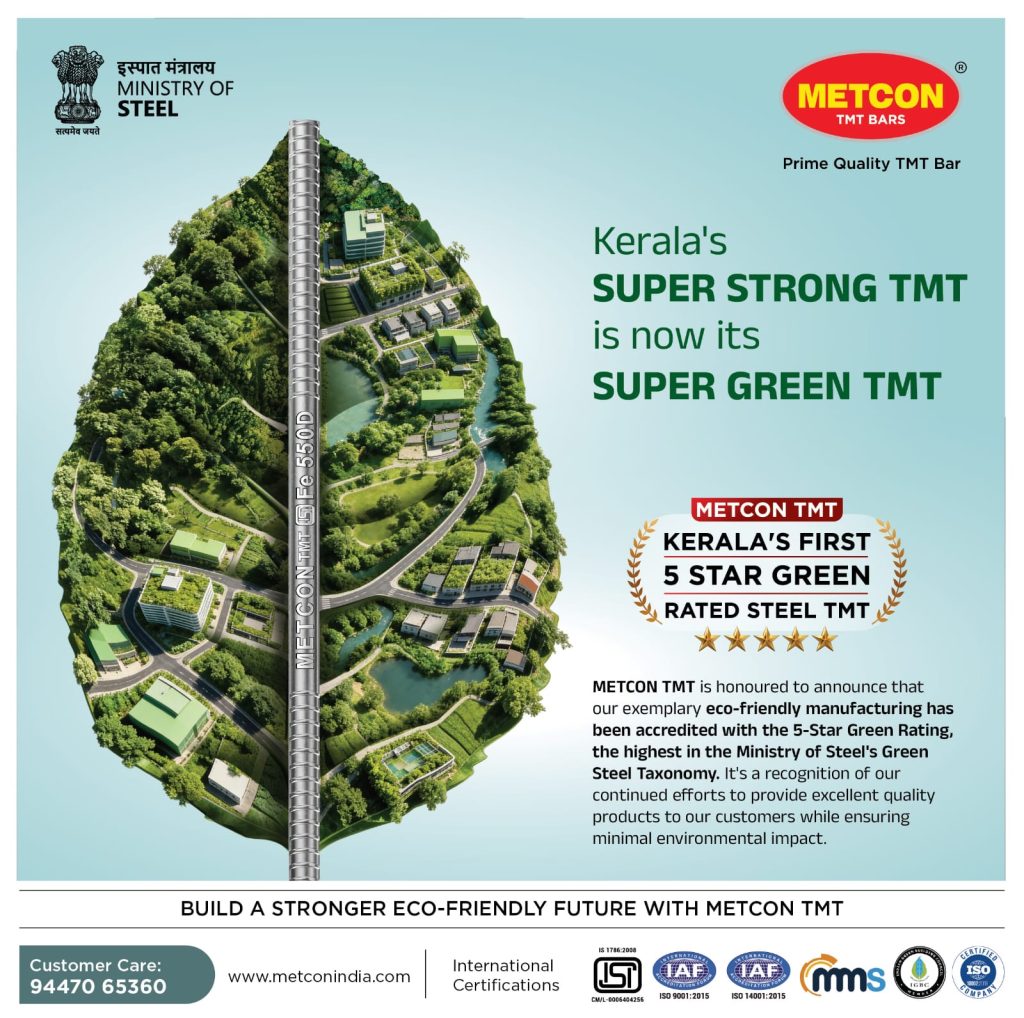
METCON Green Steel is government-approved green steel, officially certified under the Government of India’s Green Steel Taxonomy introduced by the Ministry of Steel. METCON has achieved a 5-star green rating, the highest classification under this framework, indicating that its manufacturing process maintains a carbon-emission intensity below 1.6 tonnes of CO₂ equivalent per tonne of finished steel. This certification confirms that METCON steel is produced through verified, environmentally responsible processes with a significantly reduced carbon footprint. By choosing METCON Green Steel, builders and project owners can use reliable construction steel while supporting cleaner manufacturing, sustainable development, and India’s transition towards a low-carbon future.
FAQ
What Are Green Rated TMT Bars and Why Are They Important?
Green Rated TMT Bars are reinforcement bars produced under a recognised low-carbon steel framework. Their importance is not only environmental. They bring procurement discipline, traceability expectations, and better awareness about embodied carbon in construction. For Kerala, where building activity is intense and climate exposure is demanding, that matters.
Why Should You Choose 5-Star Green Rated TMT Bars for Construction?
A 5-star rating represents the higher end of green steel classification. It signals lower emission intensity during production compared with conventional high-emission steel. For homeowners, it is a more responsible choice. For builders, architects, developers, and institutions, it supports stronger sustainability documentation.
What Makes Green Rated TMT Bars Different from Regular TMT Bars?
The difference is not that the bar looks green or behaves magically inside concrete. The difference lies in verified production emissions and certification. Regular bars may perform structurally if they meet standards, but green-rated bars add an environmental performance layer that ordinary purchasing often ignores.
What Are the Top Benefits of Using Green Rated TMT Bars?
The practical benefits are lower embodied-carbon contribution, improved sustainability value for the project, stronger documentation, better brand accountability, and a more responsible material choice without moving away from familiar reinforced concrete construction practices.
Why Is Green Certification Important When Choosing TMT Bars?
Certification gives buyers something more reliable than verbal claims. In construction, every hidden material should come with proof. Steel disappears into concrete, but the paperwork remains. For larger projects, that paperwork can matter during audits, green building submissions, institutional review, and future asset valuation.
Are Green Rated TMT Bars Eco-Friendly?
They are more eco-conscious than conventional alternatives when the rating is genuine and verified. Still, no steel product is impact-free. Steel production consumes energy and resources. The sensible word is not “perfect”. The sensible word is “better”.
Are Green Rated TMT Bars suitable for residential buildings?
Yes, provided the grade, diameter, design, detailing, and site workmanship are correct. A small house needs good steel as much as a large project does. The cost of poor reinforcement does not become smaller because the building is residential.
Can Green Rated TMT Bars be used for commercial and industrial projects?
Yes. They are especially relevant where project documentation, durability expectations, ESG concerns, green building goals, and long-term maintenance value matter. Commercial and industrial projects should still follow structural consultant specifications without substitution.
How do Green Rated TMT Bars improve building durability?
They do not improve durability by the green rating alone. Durability comes from correct steel quality, proper design, concrete cover, curing, waterproofing, workmanship, and maintenance. Their advantage is strongest when the product comes from a controlled manufacturing and supply system and is used correctly at site.
How can I identify genuine 5-Star Green Rated TMT Bars?
Ask for certification proof, verify the manufacturer, check brand marking on the bars, match invoice details, confirm grade and diameter, and buy only through authorised supply channels. Do not accept casual claims. In steel, trust should always come with documents.


