


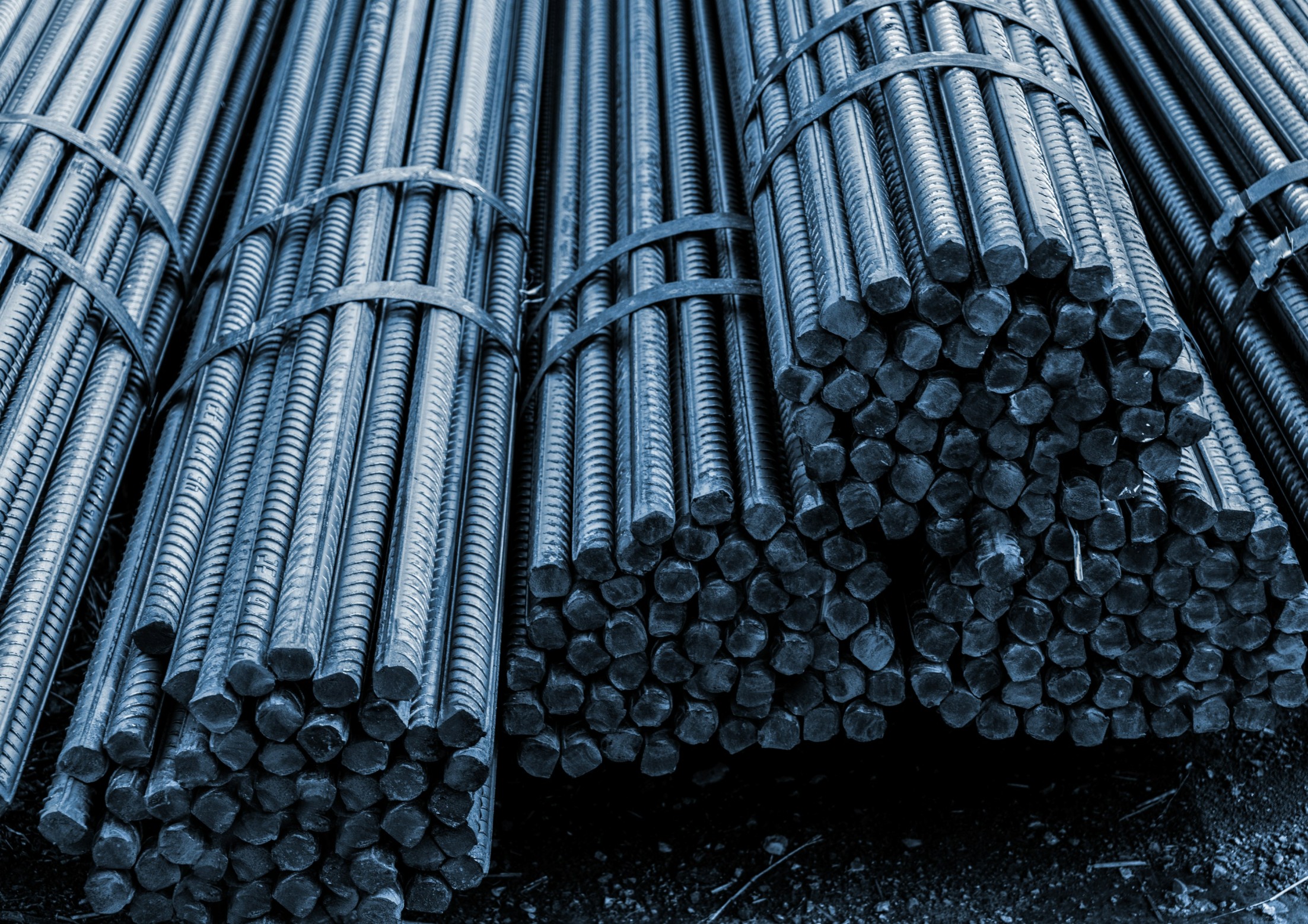
The mistake I see in discussions around reinforcement steel is the assumption that a higher number automatically means a better bar. It does not. A structural grade only becomes useful when its strength, elongation, bond behaviour, bendability and consistency suit the design in front of you.
Grade Fe 550 D is interesting because it pushes yield strength higher without abandoning ductility. Under the BIS values published by Metcon for Fe 550D, the minimum 0.2% proof stress is 550 N/mm², minimum ultimate tensile strength is 600 N/mm², the TS/YS ratio is at least 1.08, and minimum elongation is 14.5%. Those figures matter together. Reading only “550” misses half the engineering conversation.
The “D” is not decorative. It identifies a ductility-oriented grade with tighter chemical and mechanical requirements than the corresponding non-D grade. In real reinforced-concrete work, that extra deformation capacity matters around beam-column junctions, lap zones, heavily reinforced members and areas expected to experience repeated or sudden loading.
This is why TMT Steel Bars should never be bought by price per tonne alone. The correct question is what performance is being purchased per tonne, and whether the supplied batch actually matches the structural specification.
Why 550 MPa Changes the Way Reinforcement Can Be Designed
Modern buildings are less forgiving of reinforcement congestion. Columns are slimmer, spans are longer and service zones compete with structural members. Basements, transfer elements, cantilevers and open-plan layouts can all push reinforcement demand upward.
Higher yield strength can let the designer achieve the required steel capacity with a lower reinforcement area than a lower-strength grade, where the code and member behaviour permit it. That can reduce congestion and improve concrete placement around TMT Steel Bars.
But there is a trap here. Reducing steel area is not a site decision. A contractor cannot replace Fe 500 with Grade Fe 550 D and simply remove bars because the new grade is “stronger”. Crack control, minimum reinforcement, anchorage, development length, shear behaviour, seismic detailing and serviceability still govern the design. In some members the theoretical saving may be limited or disappear altogether.
Used correctly, the higher strength is valuable. Used casually, it creates false economy. For high-rise work, heavily loaded columns, commercial structures and major foundations, more strength can be carried within constrained member geometry. That is where Grade Fe 550 D starts to earn its place.
The “D” Matters When Concrete Starts Moving, Cracking or Cycling
Concrete carries compression well; reinforcement takes much of the tensile demand. The bar must still deform without losing its role abruptly when the structure is pushed beyond ordinary service conditions.
Ductility gives a reinforced-concrete member warning, redistribution capacity and energy absorption. During seismic action or local overstress, a ductile bar can sustain meaningful deformation before failure. It does not make a building “earthquake-proof”. Seismic performance still depends on configuration, confinement, joints, load path, concrete quality, foundations and workmanship.
BIS recognises Fe 550D within IS 1786 for high-strength deformed steel reinforcement. Its certification scheme covers mechanical properties, bend/re-bend behaviour, chemistry and cast or lot traceability. A test certificate is not paperwork to file away; it is the quickest check that delivered steel matches the engineer’s specification.
When evaluating a TMT Bar Manufacturer, I would look past the brochure first. Ask for the grade marking, BIS licence details, batch traceability and recent test results. A credible TMT Steel Company should be comfortable with that level of scrutiny.
Strength Is Useful Only When Bond, Bending and Site Workmanship Keep Up
The rib pattern on TMT Steel Bars is doing real work. The bar must transfer stress to the surrounding concrete through bond. Poor placement, insufficient cover, honeycombing or careless vibration can undermine that relationship no matter how impressive the mill certificate looks.
The same applies to bending. Bars are routinely bent for stirrups, hooks, column ties and congested junctions. Repeated bending and straightening is bad practice. Heating bars merely to make bending easier is worse unless an approved procedure exists.
There is also a persistent belief that stronger main bars allow lower-quality stirrups. They do not. Stirrups control shear, confine concrete and restrain longitudinal reinforcement. If a buyer is searching for the Best Stirrup in Construction in Kerala, the useful answer begins with correct grade, diameter, spacing, bend geometry and engineer-approved detailing—not a slogan attached to a bundle of steel.
Good TMT Bar Suppliers in Kerala should deliver consistent diameters, identifiable bundles and documentation that matches the purchase order. Mixed or untraceable stock is difficult to defend after it disappears inside concrete.
That is also where manufacturer identification becomes useful. Metcon states that its bars carry identifiable markings, while Fe 550D is distinguished through its grade identification and bundle information. Traceability may seem administrative while the steel is lying in the yard. It becomes considerably more valuable after ten tonnes of reinforcement have been fixed across several structural members.
Kerala’s Climate Exposes Weak Construction Practice Very Quickly
Humidity is often blamed for corrosion as though moisture in the air alone rusts reinforcement through sound concrete. The real problem is usually more complicated: permeable concrete, inadequate cover, chloride exposure near the coast, cracking, poor curing, water ingress, leaking terraces, wet service zones and badly executed joints.
Grade Fe 550 D can be part of a durable reinforcement strategy, but the grade number by itself is not corrosion protection.
For a coastal house in Alappuzha or a commercial building in Kochi, I would pay close attention to concrete quality and cover before arguing over a small difference in steel price. Storing steel directly on wet ground for weeks is another avoidable mistake.
A bar covered with surface contamination and then placed into poorly compacted concrete does not become durable because its invoice carries a premium grade.
Corrosion-resistant variants can make sense in aggressive exposure conditions. Metcon also publishes environmental credentials and discusses the five-star green rating approved by the Ministry of Steel under India’s green-steel framework for Green Rated TMT Bars. That is a sustainability issue, not a substitute for durability design. Lower production emissions and corrosion resistance are different questions. Metcon states that it has achieved a five-star classification under India’s green-steel framework, associated with verified lower emission intensity during production.
A TMT Bar Company in Kerala that understands local exposure should be willing to discuss both, without pretending steel alone can correct poor concrete.
There is another practical point that receives very little attention: reinforcement storage. Steel ordered early because the price looks favourable may sit through weeks of monsoon weather before being fixed. Keep bundles raised from the ground, maintain drainage around the storage area and avoid prolonged contact with mud, stagnant water or aggressive contaminants. Procurement timing and storage discipline are part of reinforcement quality, even though neither appears on the structural drawing.
Fe 550D Versus Fe 500: The Better Grade Depends on the Member, Not the Sales Pitch
Fe 500 remains a perfectly legitimate reinforcement grade. Fe 550D is not a universal replacement for it.
The strength difference is straightforward: Grade Fe 550 D has a minimum yield strength of 550 MPa, while Fe 500 is based around 500 MPa. The more useful comparison is strength versus ductility. Higher-strength steel can permit reduced reinforcement area, yet some designs value greater elongation. Engineers weigh those characteristics against seismic demand, congestion, serviceability and economy.
So when is Fe 550D the better choice?
I would consider it seriously in high-rise structures, heavily loaded columns, commercial buildings, industrial work and projects where reinforcement congestion is difficult. It is also appropriate in residential construction when the design specifies it.
What I would not do is approve a substitution simply because TMT bar dealers in Kerala have one grade available that week. Procurement pressure is not an engineering criterion.
Nor would I assume that moving from Fe 500 to Fe 550D automatically cuts reinforcement costs by ten per cent because the nominal yield strength has increased by ten per cent. Structural design does not work that neatly. Minimum steel ratios remain. Bar spacing may govern. Crack widths may govern. Development length may alter the apparent saving. Congested connections can dictate practical bar arrangements irrespective of the theoretical steel area.
The saving sometimes appears less in total steel tonnage and more in buildability.
That can still be valuable. A column cage that is easier to assemble, concrete that can flow around reinforcement properly and a beam-column joint with fewer congestion problems may be worth considerably more than a simple kilogram calculation suggests.
Metcon states that its Fe 550D bars are BIS-certified and identifiable through product marking and batch information. BIS documentation for IS 1786 requires certified consignments to carry test details including grade, size, cast or lot number and results. That is the level at which TMT Steel Bars should be checked.
Once concrete is poured, reinforcement is effectively inaccessible. That makes traceability unusually valuable. Tiles and paint can be changed; reinforcement in a slab, beam or column cannot be conveniently revisited.
For modern construction, that is really the case for Fe 550D: higher usable strength, meaningful ductility, better possibilities for heavily loaded or congested design, and a grade that rewards disciplined engineering. Not magic. Not automatically economical. Very effective when specified for the right reason.
FAQs
1. What are FE 550D TMT bars, and how are they different from other grades?
FE 550D bars are high-strength ductile reinforcement bars with a minimum yield strength of 550 MPa. The “D” denotes enhanced ductility requirements compared with the corresponding non-D grade. They combine higher strength with controlled elongation, tensile performance and chemistry.
2. Why are FE 550D TMT bars considered ideal for modern construction?
Yes, they are well suited to modern construction where higher loads, tighter member sizes and reinforcement congestion are common. Their higher yield strength can give designers more flexibility, provided the complete structural design and detailing are based on that grade.
3. What are the key features of FE 550D TMT bars?
The principal features are high yield strength, defined tensile-to-yield behaviour, ductility, bendability and ribbed surfaces for bond with concrete. Quality still depends on compliant manufacture, chemical control, testing and batch consistency.
4. How do FE 550D TMT bars improve the strength and durability of buildings?
Yes, they can improve structural capacity when properly designed into reinforced concrete. Durability, however, also depends heavily on concrete cover, mix quality, compaction, curing, waterproofing and exposure conditions. Steel grade cannot compensate for poor concrete practice.
5. What makes FE 550D TMT bars suitable for high-rise buildings?
Their higher yield strength is useful where columns, walls, transfer members and foundations carry substantial loads. In suitable designs it can help control reinforcement quantity and congestion, which becomes increasingly important in heavily reinforced high-rise members.
6. Why should you choose FE 550D TMT bars instead of FE 500 for modern construction?
Yes, Fe 550D is worth choosing when the structural design benefits from higher yield strength and the specified ductility is appropriate. Fe 500 may still be preferable in some designs. The engineer’s specification should decide the grade, not a blanket rule.
7. What is the difference between FE 550D and FE 500 TMT bars?
Fe 550D provides a 550 MPa minimum yield level, compared with 500 MPa for Fe 500. Fe 550D also carries ductility requirements indicated by the “D”. Actual selection depends on design assumptions, elongation needs, detailing and applicable codes.
8. Can FE 550D TMT bars withstand heavy structural loads?
Yes. Their high yield strength makes them suitable for heavily loaded reinforced-concrete members when the member has been designed for Fe 550D. Load capacity still depends on section size, reinforcement area, concrete strength, detailing and foundations.
9. What makes FE 550D TMT bars ideal for Kerala’s humid climate?
Yes, they can be used effectively in Kerala, but humidity should not be treated as a steel-grade issue alone. Proper concrete cover, low permeability, curing, drainage and corrosion control are essential, particularly in coastal or chloride-prone locations.
10. Can FE 550D TMT bars be used for both residential and commercial projects?
Yes. They can be specified for houses, apartments, commercial buildings, industrial structures and larger infrastructure. The relevant question is whether the structural design has been prepared for Fe 550D and whether the delivered material is compliant and traceable.


